Book Stall
The following items are available through Parwich & District Local History Society.
Voices: Women of a White Peak Village
Compiled and edited by Gillian Radcliffe, tells of the changing lives of women in the Peak District village of Parwich over the last one hundred years. Told in people’s own words, it grew out of a number of extensive interviews Gill undertook, when preparing a display on domestic life for an exhibition held in 2002. This mosaic of extracts creates a vivid picture of a community in relation to universal themes, such as the changing seasons, childhood, courtship, wartime, work and old age. The photographs bring the text alive, and the voices, including those of the children of the village, join together in celebrating a community that thrives despite the threat of rising houses prices and the changing rural economy. Its production was supported by an Awards for All grant. Price £5 + package and postage
“A Parwich Walk”
by Peter Trewhitt & Patti Beasley. This booklet, sponsored by Awards for All and Stancliffe Stone, was produced as part of our 2002 History Festival and in celebration of the Queen’s Golden Jubilee. It takes you around the village describing the history and architecture of what you see. It is well worth the cost just for Patti’s maps and drawings, but you also get the bonus of many photographs, both old and new. Price £2 + package and postage. (A revised version of the booklet will be available in 2024).
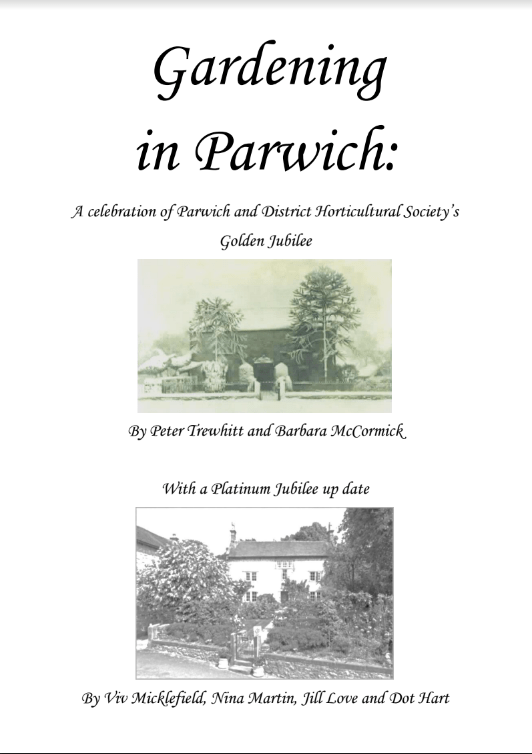
“Gardening in Parwich: a Celebration of Parwich & District Horticultural Society’s Golden Jubilee with a Platinum Jubilee update”
by Peter Trewhitt & Barbara McCormick. This splendid book contains a history of Parwich in the context of the history of British gardening from the earliest times; an account of nineteenth and twentieth century gardening in the parish; an account of the first 50 years of the Horticultural Society; and a description of some 22 local gardens that normally open on the Open Gardens Day. It contains an impressive range of colour and black & white photographs and is essential reading for anyone interested in the village, local history or gardening. It was originally produced jointly by the Local History and the Horticultural Societies to mark the Horticultural Society’s Golden Jubilee in 2002, and an updated Platinum Jubilee version is now available. Price £8 + package and postage. If you have the original Golden Jubilee version, the society supply an edition with just the updates at the cost of £3. Both the full Platinum and the updates edition are available from History Society and Horticultural Society secretaries.
A set of 8 post cards of old Parwich
The cards reproducing old photographs from the early 1900s include: The School, Main Street, St. Peter’s Church, Parwich Creamery, Drum Solo, Lord’s Joinery, Planting Cabbages, and A Village Gathering. Price £1 + Package and Postage
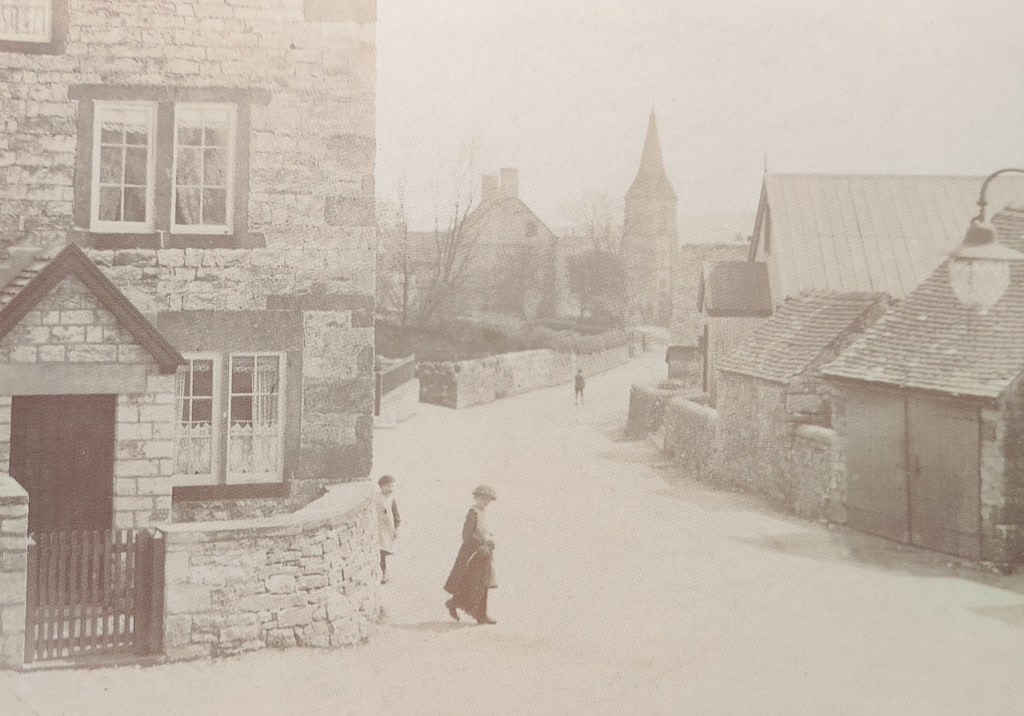
Main Street
This picture of the Main Street in Parwich, looking towards the church, was taken in the 1920s. It has changed little since then. The main change is the demolition of the Parwich Church Institute, the corrugated iron building on the right hand side of the picture. The Institute was an old army building brought here after the First World War. It served as church hall and village hall. A large cast iron stove that got very hot heated it. The children went to Sunday school here, and there were dances and social clubs here. It was demolished in 1963 when the new Memorial Hall was built. Recently the community decided it wanted to replace the Memorial Hall with a new village hall and funding is being sought for this.
The street light just in the right of the picture was a carbide gas lamp. The carbide gas was made in the small stone shed on the right of the picture between the Institute and the cart shed. This gas also powered lights in the church and Parwich Hall, as well as several other streetlights. The streetlights are now powered by electricity.
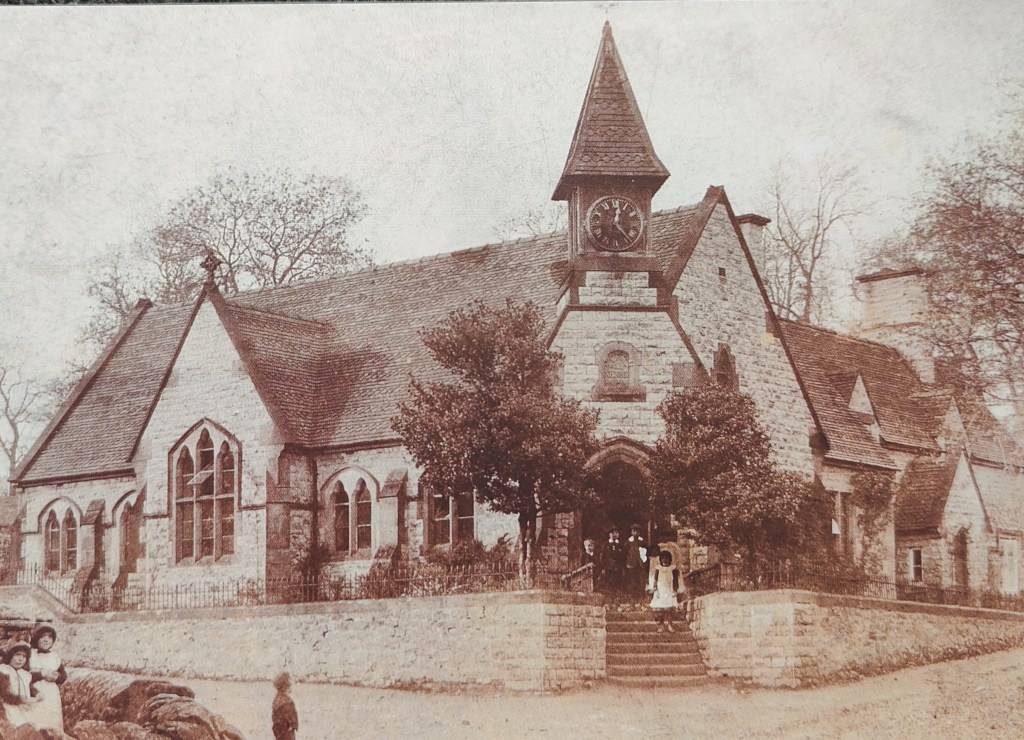
Parwich School
The School, pictured here around 1900, was built in 1861 by Sir William Evans. His father bought the Parwich estate in 1814, which included the Hall and most of the houses and farms in the parish. The Evans family were wealthy bankers and industrialists based in Derby. They lived at Darley Abbey, a very grand house north of Derby. The Evans family never lived in Parwich and they used Parwich Hall as the Vicarage. The family had built a number of schools and churches in villages they owned across Derbyshire.
This was not the first school in Parwich. There were a number of small schools in private houses at different times in the village. Also the present School replaced an earlier one established by Sir William’s father in the Hall coach house and stables.
From the outside the School has not changed a lot, except that it is rare to see it without lots of cars parked in front of it. The School continued in private ownership until 1918 when the Rev Claud Lewis, a descendant of the Evans family, sold it to the County Council. Originally half of the building was a house for the head teacher, but later this was included as part of the School. A new classroom was built on the back in 2003.
Parwich Primary School serves Parwich and the surrounding farms and hamlets. Children attend the School from the age of 4 years to 11 years, when they go to Queen Elizabeth Grammar School in Ashbourne, the market town some 7 miles away.
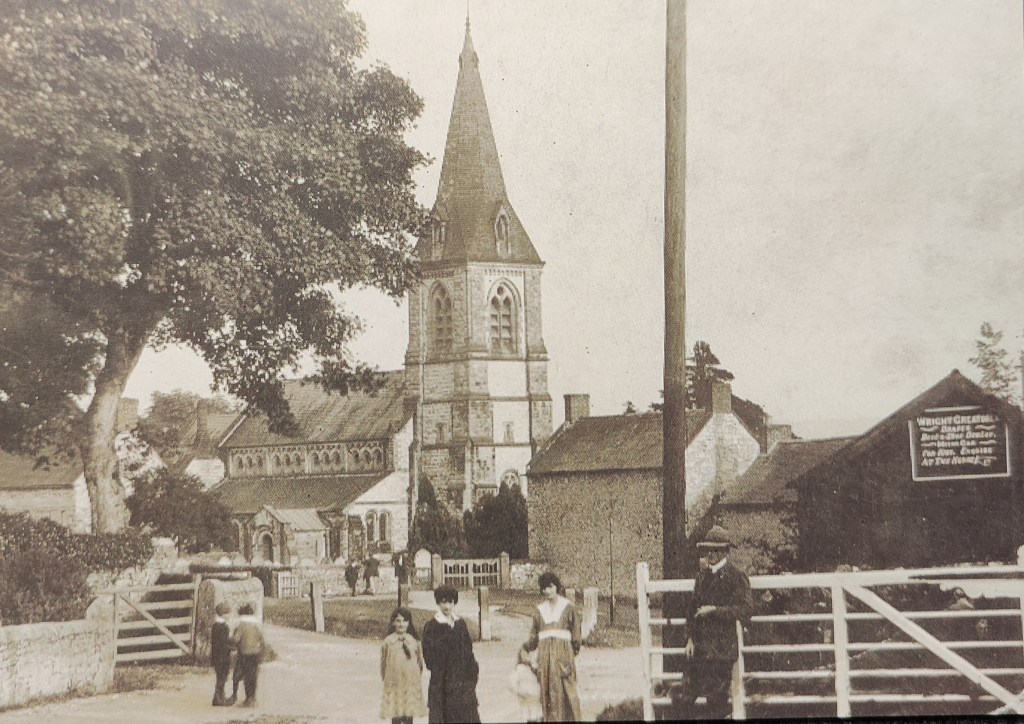
St Peter’s Church
There has been a church here for at least a thousand years. All that remains of the original church is a very old carved stone above the west door. The old Norman church was demolished in 1873. A new vicar, Rev Leighton Buckwell, who came to Parwich in 1870, complained that the old church was too small and in bad repair. He persuaded Sir William Evans to pay to have the present church built. As the Evans family had never lived in Parwich and had no ancestors buried in the church, they had no sentimental attachment to the old building. Not all the villagers were happy to see the old church go.
This view has changed little since this photograph was taken. The shed on the right is now gone. It was a hardware shop run by Mr Wright Greatorex who lived at the Fold. In the early 1900s Parwich had about 8 shops, now there is only one. Then you could buy virtually every thing you needed in the village, now most people shop in Ashbourne, or in Derby.
When this church was opened in 1874, nearly everyone in the village would have gone to either the church or the Methodist chapel. Not so many people go to church now and there is not a service every Sunday. Now the church is too big except for weddings and funerals, and the chapel closed went into private ownership in 2008 and no longer has services.
A Village Gathering
Pictured here are around 200 of the inhabitants of Parwich. There would have been around 500 people living in the parish when this photograph was taken, about the same number as today. What is different is the large number of children, about 90 in this photograph. There are not so many children now.
It is thought that this picture was taken during the celebrations for the coronation of King George V in 1911. Dr Combes when compiling the book “The Spirit of Parwich” thought that a number of people in this photograph were also in other photographs known to be of the coronation celebrations wearing the same clothes. The people are standing on the Green in front of Hallcliffe House, which was then the home of Gerald Lewis.

Parwich Creamery
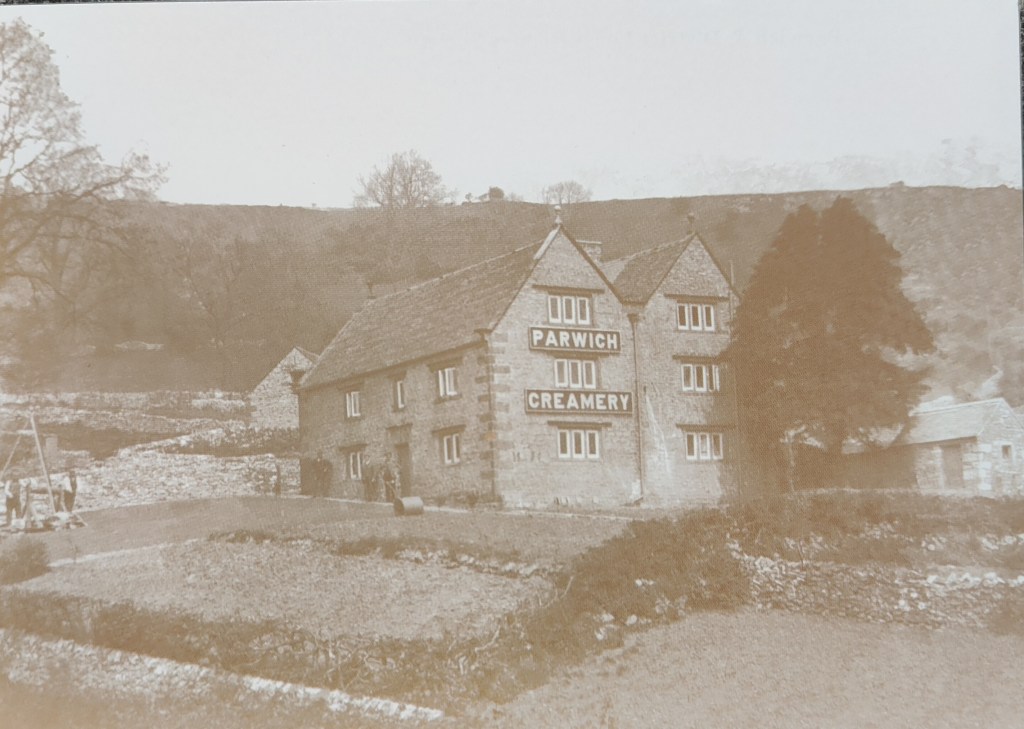
This building was built in the 1600s as an important farmhouse, and it used to be called Old Hall, this is confusing as it is newer than Parwich Hall, which was first built in the 1550s. However Parwich Hall was substantially rebuilt in 1747. Around 1900 Gerald Lewis set up a cheese factory or creamery here. Gerald Lewis’ mother inherited Parwich Hall from her uncle, Sir William Evans, and also his brother Claud Lewis became vicar in Parwich. The creamery won prizes for its cheese that was sold through a shop in Ashbourne called the Parwich Dairy. Wine and jam were also made here from the fruit Gerald Lewis grew on his market garden.
Several hundred yards away near Littlewood Farm are some brick built pigsties. A pipe ran underground from the Creamery to these pigsties so that the whey left over from making the cheese could be fed to the pigs. One reason that the Creamery was sited here was access to good water. There is still a well that can be seen in Creamery Lane, and Gerald Lewis had a borehole dug so that he could pump up fresh water. This water then supplied the factory and Gerald Lewis’ house Hallcliffe. When the Hospital (now Rathborne Hall) was built it also got its water from Gerald’s borehole. Creamery Lane took its name from the factory, which closed in the early 1920s. It then became a private house and is now known as Knob Hall.
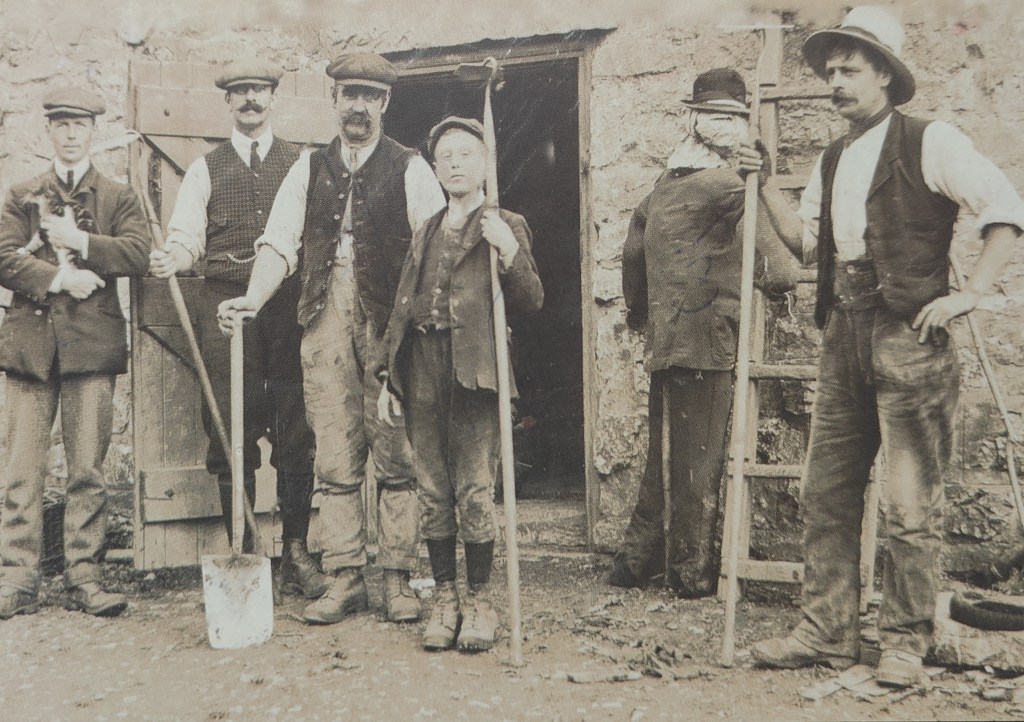
Preparing to Plant Cabbages
The men in the photograph, taken about 1910 are getting ready to plant cabbages in the market garden in Monsdale Lane. The land here should be fertile, as it was part of Parwich’s medieval open field system. Parwich had had four large open fields where the villagers had strips for growing crops. These huge fields would have been gradually divided up sometime in the 1500, 1600 or 1700 hundreds. Around 1900 Gerald Lewis set up a market garden here with fruit trees, soft fruit bushes and vegetables. He sold the produce locally from the barn in the picture and in Ashbourne, and he had the fruit preserved or turned into jam or wine at the creamery.
The men in the picture are thought to be (from left to right) Maurice Brownlee, Alfred Ernest Brownlee (junior), Alfred Ernest Brownlee (senior), Jim Lees and John Heathcote. In between Jim Lees and John Heathcote is a scarecrow with an interesting story. In 1910 there was no village hall and the school still belonged to the Lewis family. The Rev. Claud Lewis was vicar and he managed the family property in Parwich. The villagers wanted to use the school for their celebration of the coronation of King George V the following year. The Rev Lewis was not a popular man to start with and when he refused to allow the school to be used for a ‘party’ people got very angry. They dressed the scarecrow up to look like the vicar and set fire to it on the Green when the Rev Lewis came out of church.
The Rev. Claud Lewis was vicar and he managed the family property in Parwich. The villagers wanted to use the school for their celebration of the coronation of King George V the following year. The Rev Lewis was not a popular man to start with and when he refused to allow the school to be used for a ‘party’ people got very angry. They dressed the scarecrow up to look like the vicar and set fire to it on the Green when the Rev Lewis came out of church.
It is possible that Gerald knew his scarecrow was being dressed up as his brother, as he was said to have been fond of practical jokes. The Rev Lewis gave up being vicar that year and later moved to Wales. Perhaps this made Gerald Lewis realise the importance of having a village hall, as he gave the land on which the Parwich Institute was to be built. The market garden was in a frost pocket, and in the spring on cold nights they used to light bonfires to try and stop the frost damaging the flowers on the fruit trees. This must have been hard work, and in the 1920s travelling shops started to come to Parwich and the bus service to Ashbourne began. This meant that people could get a better selection of cheaper vegetables outside the village. Gerald Lewis sold the market garden in the early 1920s, and the people who bought it failed to make a go of it.
A few of Gerald Lewis’ apple trees still remain and more have since been planted.
Drum Solo
This picture was taken in 1917. The ‘musicians’ are the builders working on the new vicarage. It seems strange that they would be building a new house during the war, but when the Lewis family sold up the Parwich estate the Hall could no longer be used as the vicarage. A firm of builders from Ashbourne was employed to build the house, which must have seemed very modern indeed when it was first built.

Lord’s Joinery
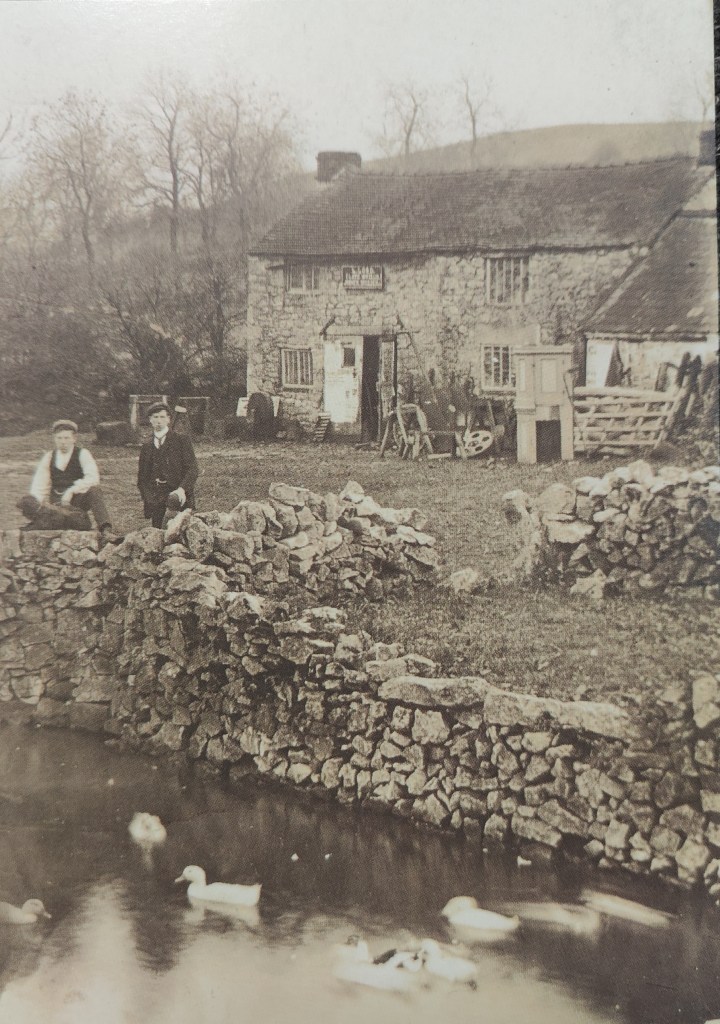
This picture was taken on the green by the Dam (the village pond) near where the play area is now. The old building in the background was a house in the 1800s, but it became a joiner’s workshop in the early 1900s. Mr Lord, the joiner, lived at Ivy Cottage on the Green. The two-storey part was demolished sometime in the first half of the 1900s, but the single storey part on the right continued as a blacksmith’s workshop until it was demolished in the 1970s to make way for the flats and houses in Smithy Close.
Delivery in Parwich village is free. For all other UK destinations the relevant package and postage costs will apply.
To make an order please email the following information to parwich.history.society@gmail.com
Name
Address
Postcode
Tel/Mobile
Email address
Details of the titles / publications you wish to order
 Parwich & District Local History Society