May 2005
Lead Mining in and around Parwich
Lead mining has occurred in the Peak District from before the Roman period. The earliest representation of a lead miner in the area is the Saxon carving of ‘T’owd Man’ complete with pick and ‘whisket’, in Wirksworth Church (see illustration below).
Very little is recorded about mining in Parwich. We are very much on the edge of the lead field and though there was plenty of prospecting here, it is likely that there was not a lot of financial reward. Certainly any mining would have been a part time activity in association with agriculture. There are conspicuous lead rakes at Lombard’s Green and on Parwich Moor and a number of shafts on the southern slopes of Parwich Hill (some over seventy feet deep); the earliest O.S. maps mark more shafts than have currently been identified (so stick to the footpaths).
The Romans made a beeline for the Peak District, setting up mining operations here within 40 years of the Invasion. This was controlled by the administrative centre Lutodarum, thought to be now submerged under Carsington Water. There are a number of Romano-British sites in the area known to have engaged in lead mining, including those at Rainster Rocks, Roystone Grange and in Parwich at Lombard’s Green. It is possible that there was also lead mining on Parwich Hill at this time. In the fourteenth century, a Mr. Lambard is thought to have mined lead at Lombard’s Green, hence the name: ‘green’ being a corruption of ‘greave’, an old word referring to mine workings (See “The South Peak Archaeological Survey”). Pilkington’s eighteenth century account of Derbyshire incidentally mentions lead prospecting in Parwich, but does not say if it was successful (see Newsletter 5).
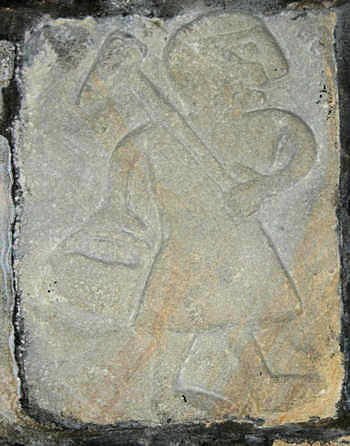
Saxon carving of T’owd Man in Wirksworth Church. Image Copyright © 2007 Michael Radcliffe
From Anglo-Saxon times mining in Derbyshire was regulated by Barmote Courts, those remaining being some of the oldest courts still regularly sitting in England. Parwich does not feature significantly in the known court records, suggesting that mining here was early and small scale. All that is preserved relating to Parwich involves exploratory digging in the late nineteenth and early twentieth centuries. However the court records are scattered and it is still possible more will turn up.
Parwich is within the Wapentake of Wirksworth, a political division dating from Saxon times, and thus is under the jurisdiction of the Wirksworth Barmote Court, one of the few remaining courts. The following are records of correspondence between the Barmote Court at Wirksworth and various individuals, summarised from the archives at Chatsworth. (See “Calendar of the Barmaster’s Derbyshire Lead Mining Records belonging to the Duchy of Lancaster and kept at Chatsworth House” arranged and described by Roger Flindall and produced by Lynn Willies for the Peak District Mines Historical Society in 1998). The extracts for our area are fairly matter of fact, so before listing them here, on a lighter note, is part of a letter relating to Castleton: Letter from John Bradwell to John How on 1 Sept. 1851. “I am happy to inform you that I am improved in health, I drink none; smoke none; eat but little; think as little as I can; talk about half as much as usual, and write scarcely any. I sleep all I can, work none, and walk about like a gentleman.”
At present we do not know the location of all the following mines, though it may be possible to make an educated guess from clues in the records. The majority of the records refer to lead mining, but there is also mention of iron ore in Parwich and ochre at Minninglow Grange in Ballidon.
1. The sale by Joseph Twigg, lead miner of Youlgreave, to Thomas Yates, labourer of Parwich, for 10s, of ¼ share in General Wolfe Mine, situated in lands occupied by William Bunting in the Parish of Ballidon 3 June 1856
2. Ref. to sale of Lumber Rakes and Long Rakes in the Parish of Parwich 26 Aug 1873 to William Fidler Mason of Edale, Farmer, by Henry Charles Heathcote of Winster, draper & druggist for £1 10s. A definition of the titles given by the Barmaster on 2 Oct 1850, lumber rake: 13 meers extending from the turnpike road opposite Mr. Saint’s Barn and ranging across 2 fields now or late in the procession of James Swindell westwardly and crossed with 2 ranges of crosses. Long Rakes as given by the Barmaster on 15 May 1833 6 meers north from the founder, 6 meers south, 3 meers east & 3 meers west.
3. Sale by Sarah Allsebrook of Burton-on-Trent, widow, to William Johnson of Parwich, miner of all those shares of mines in Brassington Liberty belonging to her viz 24/24 Narlow mine Tissington, 24/24 Cross Low Bank mine, 12/24 Tantara-bonus mine, 12/24 Hollow Cliff mine, 12/24 General Wolfe Mine, for the sum of 6d 25 Sept 1880
4. Notice to Edward Daniel of Cheadle that if his mine called General Wolfe near Parwich, is not put into workmanship within 3 weeks it will be given away 8 Jan 1876
5. Letter from the Lead Properties Development Syndicate of 23 Philpot Lane, Eastcheap, London EC 26 July 1913. We are interested in the following mines in Brassington Liberty, viz. Halls Mine (at Eaton & Alsop), Nancy Mine (at Tissington), Rushycliffe Mine (At Tissington), Rogers Folly (at Brassington) Ballidon Moor Mine, Bank Mine (at Eaton & Alsop), General Wollfe Mine (at Brassington & Parwich), Narlow Mine (at Thorpe), Hipley or Catholes Mine (at Ballidon). Also White Rake & Green Rake on Biggin Moor.
6. Reply by Barmaster 29 July 1913 White Rake & Green Rake are in Hartington Liberty
7. Letter from Peveril Turnbull of Sandbrook Hall 20 Jan 1914. I have joined Rev C E Lewis in working mines at Parwich ref Holly Cliff, Goulds Hill & Hill field mines in the Brassington Barmasters books.
8. Letter from Rev Claud E Lewis of the rectory, Bentworth Alton Hants 27 Jan 1914 (Ref mines) and uncertainty to which mines they own.
9. Letter from Rev C E Lewis 31 Jan 1914. I am now working a mine at Parwich Hill.
10. Letter from James Weston of west View Parwich ref the measures at Hipley mine 12 May 1915
11. Ref Norlow Mine, Tissington 33 May 1917. Ref White Edge mine Parwich 20 April 1918. Ref in Barmasters Books to Hollingworth (now called Hope) on Parwich hill and Beckinshaw mines all in Brassington Liberty.
12. Notice to William Allesbrook of Burton-on-Trent, botanist, that unless his mine called General Wolfe near Parwich is put into workmanship within 3 weeks it will be given away 13 Oct 1911
13. Letter from J B Brownson of Brownson & Page estate agents, Wardwick Derby 13 Oct 1911. There are many mines in the upper part of Parwich Village: 1 or 2 have been worked in the last 8 or 10 years: 1 or more was worked very perfunctorily by the Rev C Lewis who is a large land owner in that Parish. In Tissington & Newton Grange much work was done by the Nancy Consols Mining Co: the east & west vein was ½ mile north of Tissington Church at Hanger Hill & extended ½ mile NW to Newton Grange where shafts remain today. There are 1 or 2 very old mines in Thorpe pasture. A detached part of Thorpe Parish was put with Newton Grange Parish some 30 to 35 years ago and some old workings there came pretty close to the Nancy Consols near Newton Grange House.
14. 16 Jan 1912 letter from Rev C E Lewis of Parwich Hall. Yesterday began trials at 4 old mines which I acquired 2 or 3 years ago, but I think there was a 5th mine at the far end of Hawkslow Farm
15. Letter from Gerald W Lewis of Hallcliffe Parwich 16th Jan 1912. I have been working a vein (I have since been told is an old vein) situated near some claimed by my brother (Rev C E Lewis) close to Two Dales Barn at the angle of the high road about ½ way between Fentem’s farm at Hill Top & Bunting’s farm at Low Moor. Am I entitled to make a trial?
16. Barmaster’s reply to above 22 Jan 1912. You may work the vein but will have to free it if it is new.
17. Letter to Rev C E Lewis 29 Jan 1912. I can send you copies of 8 entries re your mines at Parwich.
18. Letter to Gerald Lewis 29 Jan 1912. Re his mine at Parwich and the selling of iron ore.
19. Letter from R Wooddisse of Minninglow Grange 13 Aug 1931. A valuable mare fell down a shaft in a field (no 63 on OS 1899 Ed) in Minninglow Grange Farm in Ballidon Hamlet. Who owns the shaft? We have heard that Mr Beck worked it, drawing ochre up the shaft in a bucket.
20. Reply to the above from the Barmaster 15 Aug 1931. The mine is not referred to in the records of the last 23 years. What are the names of the fields in that locality?
21. 19th Aug 1931 letter from R Wooddisse enclosing field names.
22. Reply from Barmaster 20 Aug 1931. I have gone back through the records to 1839 but can find no reference to it.
23. Letter from F Hall of Roston common 30 June 1938. Re lead mining at Parwich on land occupied by Mr Kirkham, Parwich Leys. The site selected for trial is by Winnet Quarry on the Parwich to Alsop-en-le-Dale Rd is it in the Wirksworth Wapentake?
24. Letter from Barmaster 2 July 1938 Yes.
25. Letter from S R Swindell of Lenscliffe to Wirksworth U.D.C. 1 Dec 1948. Asking about a person’s rights to search for lead veins.
Also, in this context, it is interesting to note the following plaque, now on the front wall of Willow Cottage on the Green: “Success, Rushy Cliff, and Nancy Consols Lead Mining Co Ltd. Notice Trespassers will be prosecuted according to law by order Derby Nov 1872”. This plaque was found below Gibbons Bank and may be associated with the capped shafts near the houses there, or those further east. This company was more active in Tissington and it is thought that their shaft(s) here were exploratory, never being worked commercially (see Newsletter 6).
To understand more of mining in the parish a full scale survey is required, and the likelihood that small shafts and rakes have been filled in and deeper shafts capped necessitates excavation. Anyone wanting to find out more about mining is referred to the Peak District Mines Historical Society and their museum and library at the Pavilion in Matlock Bath, which has one of the most comprehensive lead mining libraries in the country. (See www.pdmhs.com or www.peakmines.co.uk )
Copyright © 2005 John Peel
Glossary
Parwich is in the Liberty of Brassington, which, as part of the Soke and Wapentake of Wirksworth, is under the jurisdiction of the Wirksworth Barmote Court (also called the Court for the Low Peak). Presumably there was not sufficient activity to warrant a separate liberty for Parwich, Alsop en le Dale, Ballidon, etc. The mineral rights for the High and Low Peak Liberties in general belong to the Crown (Duchy of Lancaster) and make up what is referred to as the Queensfield. The following definitions are taken from J H Rieuwerts (1998) “Glossary of Derbyshire Lead Mining Terms” published by the Peak District Mines Historical Society Ltd at Matlock Bath.:
Barmaster, Barghmaster, Bergma(e)ister, Barmer: The executive officer of the Barmote Court appointed by the Crown in the Queensfield, or by the Duke of Devonshire, the Duke of Rutland and others as Lords of their own liberties. The owners of smaller private liberties such as Litton, Grindlow and Griffe Grange have, or had, the power to appoint their own Barmaster. The position existed before 1288, but its origin is unknown. Traditionally the Barmaster was elected by the miners and in 1650 it was stated that: “… the cheife Barrmr is made by Letters Pattents under the Duchy Seal and the under Barrmrs are appointed by him or ellected by ye Myners” [Slack, 1988]. Hopkinson [1644] asserted the privilege of election had been taken from the miners during the reign of Elizabeth I, however in 1665 the Low Peak articles began by reiterating the miners’ right to elect their Barmaster. These contradictory statements can be resolved by two 15th century references, the first in 1415 when it was said that: “the Barmaster is made by the King”, the latter dating from 1482 at which time the Barmastership of Wirksworth was appointed by the Crown. The conclusion must be that the Head Barmaster was appointed by the Crown, Deputy Barmasters were then either chosen by him or elected by miners. The Barmaster was and is yet, assisted in his duties by a jury of miners who formed ‘the Body of the Mine’. Until the decline of lead mining there were several Deputy Barmsters, in larger liberties there were sometimes three of them. The principle responsibilities of a Barmaster were: to summon the Court; regularly walk through his liberty to inspect mines and ‘nick’ the stows when required; attend freeings and transfers of title; layout the meers; provide a dish for ore measurement and perform such measurements at each mine; ensure that the lot and cope were collected and collect other duties such as meer dishes on behalf of the Lord of the Field; lay out mineral roads to the mine and to water. He assisted the jury when Bills of Complaint were preferred and arrested mines in dispute. Before the Parliamentary Acts of 1851 and 1852 he acted as coroner in cases of death at or in a mine.
Barmote Court [Great and Small]: The legal administrative unit governing the Derbyshire lead mining. The Court is presided over by the Steward, assisted by the Barmaster and a jury of twelve [formerly twenty four] miners or maintainers of mines for the Great Court, but only twelve for the Small Court. The origin of the Court is obscure, but it probably evolved during the Anglo-Saxon period. Traditionally it originated in the ‘Germanic’ mines of Central Europe, hence Bergmote and Bergmeister, the alternative spellings in early documents [Reiuwerts, 1988]. The ‘Barmasters Court’ recorded in the Quo Warranto of 1288 met every three weeks at the mining sites. The later Small Barmote Court also met on the mines every three weeks or when required. The Great Court was in existence by 1415 though no founding date is known. The duties of these mineral courts were many and varied and included giving decisions on the ownership of disputed mining titles, payment of mineral debts and forfeiture of shares, verdicts on deaths in mines, ‘sizing’ [calibrating] wooden measuring dishes against the Standard Dish and assisting the Barmaster at freeings and ore measurement [Willies. 1988]. The geographical location of the Courts within the orefield and their frequency was complex and not uniform. The principle courts were those held for the Low Peak, the High Peak and those belonging to the Duke of Devonshire and the Duke of Rutland. Barmote Courts for smaller liberties have been held from time to time, such as those for Stanton, Grindlow, Litton and elsewhere, but most were short lived and were defunct before 1750. The Litton Court was an exception and survived well into this century.
Barmo[o]te Hall, Moot Hall: The building in which sittings of the Barmote Court are held. The present structure in Chapel Lane, Wirksworth, houses the Court for the Low Peak or Soke and Wapentake of Wirksworth. At least three and possibly four halls have existed, the earliest being built about 1498. Beneath the courtroom were various shops. Some claim that this hall was built at the expense of Roger son of Sir Henry Vernon, whilst others deposed that the King had borne the cost [Duchy of Lancaster]. By 1608 the Moot Hall was ‘much decayed’. A description of the Moot Hall in 1649, stated that it was built of timber and the courtroom was on the first floor above open bays which served as butchers stalls. This description appears to fit the original late 15th century hall. Its appearance was probably similar to the Market Hall in Winster. Nothing is known about its later history or whether another building was erected. In 1773 the ‘old Moot Hall’ was demolished and a most imposing structure was then erected on the same site at the northeastern corner of the Market Place. It was demolished when the square was extended. The present plain, one storey building was constructed in 1814 [Rieuwerts, 1988]. Barmote Courts held elsewhere in Derbyshire do not appear to have had a purpose made Moot Hall like the Wirksworth example. During the 19th century, at least, sittings of the High Peak Court were held at various public houses, such as the Angel in Winster and the Bulls Head, Monyash.
Crosses and Holes: When a vein was newly discovered the miner could mark his find with a cross and hole cut into the turf or soil. This mark was lawful for only as long as the miner could go home and make himself possession stows, or for a maximum of three days. … …
Liberty, Mineral Liberty:The district in which the miner works, governed by a set of laws and customs. The boundaries of a liberty usually coincide with those of the same parish, for example Castleton parish and Castleton Liberty are identical. Anomalies exist, for instance parts of Tideswell parish lie within the liberty of Bradwell, whilst the position of the boundary between Cromford and Middleton liberties has changed since the early 18th century. The principle mining liberties are those groups belonging to the Crown, comprising the High Peak and the Low Peak, those belonging to the Duke of Devonshire and some belonging to the Duke of Rutland. Smaller liberties belong to Lord Scarsdale and others.
Meer: A linear measurement along a vein, irrespective of its width or depth. The title to all mines was laid out by the Barmaster’s chain, a miniature stows, known as possession stows, marking the extent of each meer and signifying ownership. The length of the meer varied, in Youlgreave and Haddon Liberties it was 28 yards, in the Soke and Wapentake of Wirksworth 29 yards and in the High Peak it was 32 yards. The origin of the system is not known, it is popularly assumed that it originated during Anglo-Saxon times and was derived from the Saxon mining codes. The earliest reference so far located relates to ‘le findemeres’ in the Over Haddon-Taddington area in 1287 [Rieuwerts, 1988].
Ochre: A miner’s name for a variety of earthy minerals, being oxides of iron and manganese. These minerals exhibit colours ranging from black, through brown, orange to red. They were also known as raddle, umber and wad or black-wad.
Old Man, T’owd Man, Old Man’s Work: There are three different meanings:-
[i] Former miners, or the miners of previous centuries. The rich ribs of ore had been largely removed from the upper parts of the veins by about 1600 and it was then said that the miners “must be glad to glean after the ould mans harveste”. [Also] The spirits or ghosts of long dead miners.
[ii] Waste rock packed into old stopes. The Barmote jury, when called to view a mine, often found such waste obstructed their inspection. At a mine on Harborough Rakes, Brassington the jury “viewed where Moses White struck to old man or rubbish, but we cannot tell what old man it is unless the ground was bared and more laid open”, September 27th, 1718 [Rieuwerts, private collection].
[iii] Places in a mine worked out by former miners. Sleigh [1865-66] defined Old Man’s Work as the workings in a mine of which there is no record. He also called these ancient workings Carls-work or Carls-wark. An undated account refers to a miner investigating old workings on Brassington Moor: “Carl’s Work or Old Man’s Work as these old workings are called” [Youlgrave, 1931].
Rake: One of the principal forms of mineral deposit found in Derbyshire. Essentially a vertical, or sub-vertical fissure, formed as a fault structure during earth movements and subsequently filled with lead ore and associated gangue minerals. Most rakes consist of a series of parallel fractures occupying a zone which might be as much as fifty yards in width; they are characterised by their considerable length, generally between two and five miles. No rake has ever been bottomed, but the payable mineralisation is usually confined to the upper four to six hundred feet.
Historically, before the advent of the ore-hearth furnace in the latter part of the 16th century, the word must have had a different meaning because the entire width of a rake, as presently revealed, would not have been worked. Only rich ribs of ore were economically viable and workings along the rakes would have been by opencast trenches, or as narrow slits excavated into the rich ribs of ore. Along the rakes development of the slits reached depths in excess of 200 feet. The remainder of the rake was left in-situ as being worthless. The introduction of the ore-hearth furnace allowed extraction of ore disseminated within the remainder of the rake, largely by opencast methods c. 1600-1700.
Therefore rakes such as Nestalls Rake, recorded in 1470; Dirtlow Rake, Castleton, 1538; Dun Rake, Cromford, 1542; and Strawberry Rake, Longstone Edge, 1572, cannot refer to the full width workings eventually developed and currently visible.
In 1633 Dovegang Rake, now identified as a large vein complex, was described as being only 5 or 6 feet in width, but 240 feet in depth and about quarter of a mile in length.
From: “Till the Doctor Comes”
This little book, written by George H. Hope, was presented to Sarah Ann Lowe ‘For Good Attendance At the Wesleyan Sunday School, at Gillowshaw-Brook’ on March 8th 1874, an age in which medicine was rudimentary, antibiotics unknown, and operations undertaken with or without chloroform. The book was lent by Florence Harris.
“A short time since a man met with an accident, having his wrist cut with a piece of broken jug. This man, residing in one of the largest cities of the world, surrounded by thousands of people, the largest hospitals, and the best doctors, was allowed to bleed to death, and his wife had to stand her trial for murder, all for the want of a little knowledge, a little common sense, used at the proper time.
The occurrence much impressed my mind with the need of a few hints and instructions as to what is best to be done in the case of accident or sudden illness, especially by those who reside at a distance from the nearest surgeon… But no one can always foretell whether a matter will prove serious or not. What I may write, therefore, is not to take the place of advice or care of a doctor, but merely that people may employ the time profitably while they are waiting TILL THE DOCTOR COMES.
… Of all the miserable hindering nuisances, there is nothing worse than persons who, just at the time when their services are most required, begin to scream, run wildly about, put themselves in everyone’s way, hinder other people, not able to give a sensible answer, perhaps faint, or go into hysterics, or pretend to do so.
Every one knows that all have not the same strength of nerve. Most people have naturally a feeling of dread and of nervous horror at the sight of blood; …Still, much can be done by mere force of will, determination, facing the thing bravely… Some ignorant people will tell you that a doctor has no feeling for his patient, but they know little of the truth. Ask those who live with them, and hear their remarks about the painful operation they have had to perform, and how nobly the poor patient bore it. Ask Florence Nightingale and the noble women who without pay or reward attend in our hospitals, and in the dwellings of the poorest of the poor, who witness and dress every description of wound or accident… Do they not suffer when others are in pain? Yes, truly, but they have taught themselves to bear it, so they can overcome their feelings. Let us strive to conquer ourselves, to be calm when accidents happen or sudden illness comes, so that we may be useful to others in our distress.
A curious instance, but a very instructive one, occurred to me some years ago, before chloroform was invented. A large, well-made, healthy seaman was brought into the hospital with his leg so terribly crushed that it was necessary to take it off some distance above the knee. I said to him, “Jack, I am very sorry to have to tell you, that the only thing which can be done with this unfortunate leg is to take it off; we cannot save it, you know we cannot splice it or fish it like a mast.”
“No,” he replied, “I can see that; well, it must be done, it ‘ill never be seaworthy any more; how long will it take doing it?” So I told him only a very short time. “Oh well,” he said, “cut the wreck adrift, and fit a timber one, I’ll bear it.”
So the limb was taken off without one groan or one word of complaint. But as the house surgeon was putting on a bandage, he accidentally pricked him with a pin, when he immediately cried out, “Hallo, Mr. Surgeon, the point of that marling-spike’s rather sharp, that’s too bad.”
So I said, “Why Jack how is this? – you bore having your leg taken off like a brave fellow as you are, without speaking one word, and now when only the point of a pin touches you, you call out?”
“Ah, sir,” he said, “don’t you see, I made up my mind to have my leg cut off? I told you I’d bear it, but I made no bargain about the pin-sticking business.”
Note: In Parwich in the nineteenth century there were two Dr. Twigges (father and son) at Sunnyside then at Fernlea. Were they any relation to the Dr. Twigge in Hartington in the early twentieth century? By 1901 a Dr. Potter had moved into Fernlea. If you have any information on Parwich doctors or local medical practises, David Evans of Townhead would be pleased to hear from you.
Extracts Copyright © 2005 Gillian Radcliffe
The Ball Family in Parwich & Tissington
Charles Tongue contacted the Society last year in relation to his genealogical research into a number of Parwich families. He is descended from the Ellis family who lived at Brook House in the early nineteenth century, but has extended his research into connected families, including the Balls, Beresfords, Dales, Dakyns and Roes. We hope to be able to include more of his research in future Newsletters. In Issue 16 Feb 2004 p.5 we had list of the entries in the Parish Register relating to the Ball family, including, somewhat embarrassingly, an error: John Ball was baptised in 1701 and not in 1706 as appeared in my article. The name ‘Ball’ is preserved in a field name ‘Ball Croft’, which for a number of years was used during Wakes for the carnival. It is next to the bowling green and tennis court, on Creamery Lane, though the three modern detached housesnow occupy what was the front part of this field. As a result of his contact with the Society Charles Tongue is now working with Glynn Roe, also descended from the Parwich Roes (see Newsletter No. 14 Sept 2003 p.17). Opposite are Christopher Tongue’s and Glynn Roe’s combined genealogy for the Ball family drawing on wills as well as the parish registers. The family seemed to move back and forth between Parwich and Tissington. They then seemed to abandon Parwich, though Roe, Kirkham and Keeling descendants remained in Parwich on into the nineteenth century and beyond.
Balls not yet linked to this family tree
Most of the events in the Parish Register seem to be related to individuals in this pedigree, with the possible exception of one death and two marriages. The death is that of William Ball in 1742, aged 100 years. He would have been born around 1642. The Parwich parish registers only survive from 1640 and the first registers are incomplete and not always easy to read. So it is possible he was a son of the first Thomas shown below. The first marriage is Elizabeth Ball to Thomas Sellars of Parwich in 1709, though she could be the Elizabeth born in Tissington in 1690. The second is Mary Ball to Thomas Doncaster of Parwich in 1758.

Copyright © 2005 G. Roe and C. E. Tongue
The Hadfield Family in Parwich
Sandra Tomkinson (Member of the Society) is researching the Hadfield family. Their first documented link with Parwich is:
Isaac Hadfield of Bradbourne married Elizabeth Horobin of Parwich 15th November 1779 (Isaac died in Parwich in 1802.) (Note the Hadfields of Park House Farm in Bradbourne are descended from Parwich Hadfields).
The Hadfields lived in various properties in Parwich between 1779 and 1923:- Lenscliffe, the Bank, Yaid (?) Farm and the Alley. We can not now identify all these properties, but on the 1843 Tithe Map John Hadfield was occupying Mill Croft, Lenscliffe which is now demolished. This house was on the corner of Alsop Lane and the lane up to Lenscliffe on the side furthest away from the Chapel (where Bill Austin’s house now stands).
The last of Sandra’s direct ancestors to live in Parwich was her great grandmother, Harriet Roberts (née Hadfield) 1868-1923. On the 1901 census Harriet and her husband Joseph Roberts had three children, including Ann Elizabeth (Sandra’s grandmother). She was born on 22nd July 1890 with a twin sister Elizabeth Ann. They were baptised in Parwich Church on 27 July 1890. In the 1891 census the twins, 8 months old, are living with their mother in Brassington. On the 1901 census Harriet has moved back to Parwich with her new husband, but with only one of the twins (Ann Elizabeth. What happened to Elizabeth Ann; so far Sandra has not been able to find any record of her great aunt’s death or burial? Can anyone help?
Hadfields in the Parwich Censuses
| 1841 | Birtha Hadfield | 3 | |||||
| Lenscliffe | John Hadfield | 25 | Ag Lab | Arthur E Hadfield | 9 mths | ||
| Ellen Hadfield | 25 | Charles Potter | 40 | Lodger* | |||
| William Hadfield | 6 | ? | Isaac Hadfield | 35 | Ag Lab | ||
| Elizabeth Hadfield | 4 | Sarah A Hadfield | 32 | Wife | |||
| Frances Hadfield | 6 mths | William | 6 | ||||
| ? | Isaac Hadfield | 60 | Ag Lab | Hannah Hadfield | 3 | ||
| Maude Hadfield | 55 | (Wife) | Alice Hadfield | 9 mths | |||
| Ann Hadfield | 15 | Mary Kirkham | 68 | Mother-in-law | |||
| William Hadfield | 10 | ? | John Hadfield | 66 | Labourer | ||
| Sarah Hadfield | 2 | Mary A Hadfield | 33 | Daughter | |||
| 1851 | Christina Hadfield | 13 | Granddaughter | ||||
| Lenscliffe | John Hadfield | 36 | Ag Lab | Yaid Farm | William Hadfield | 46 | Farmer 33 acre |
| Ellen Hadfield | 40 | Wife | Lydia Hadfield | 49 | Wife | ||
| Fanny Hadfield | 10 | Thomas Hadfield | 17 | ||||
| Isaac Hadfield | 8 | Joseph Hadfield | 11 | ||||
| John Hadfield | 6 | Walter Hadfield | 9 | ||||
| Margaret Hadfield | 4 | Susan Hadfield | 6 | ||||
| George Hadfield | 2 | ? | George Hadfield | 19 | Servant | ||
| Harriett Hadfield | 1 | 1891 | |||||
| Church Farm | William Hadfield | 15 | Farm lab. | ? | Isaac Hadfield | 49 | Labourer |
| ? | Elizabeth Hadfield | 14 | Servant | Sarah A Hadfield | 42 | Wife | |
| ? | William Hadfield | 19 | Hannah Hadfield | 13 | |||
| Sarah Hadfield | 12 | Alice Hadfield | 10 | ||||
| 1861 | Thomas E Hadfield | 9 | |||||
| ? | William Hadfield | 25 | George Hadfield | 7 | |||
| Lydia Hadfield | 30 | Mary E Hadfield | 4 | ||||
| John Hadfield | 4 | ? | George Hadfield | 29 | Ag Lab | ||
| ? | John Hadfield | 46 | Elizabeth Hadfield | 33 | Wife | ||
| Ellen Hadfield | 52 | Francis J Hadfield | 7 | ||||
| Charlotte Hadfield | 8 | Alice M Hadfield | 5 | ||||
| Church Farm | Isaac Hadfield | 21 | Harold Hadfield | 3 | |||
| ? | Maude Hadfield | 75 | James Hadfield | 1 | |||
| William Hadfield | 30 | Nether Green | William Hadfield | 16 | Farm servant | ||
| Sarah Hadfield | 25 | ? | Ralph Nadin | 26 | Labourer | ||
| Mary Hadfield | 4 | Jenny Nadin | 26 | Wife | |||
| Isaac Hadfield | 2 | Hannah Hadfield | 6 | Stepdaughter | |||
| Maud Hadfield | 2 mths | ? | John Hadfield (widower) | 46 | Labourer | ||
| ? | George Hadfield | 11 | Lizzie Hadfield | 18 | |||
| 1871 | Arthur Hadfield | 10 | |||||
| Nether Bank | John Hadfield | 26 | George Hadfield | 7 | |||
| Harriett Hadfield | 22 | Harriett Hadfield | 3 | ||||
| Annie Hadfield | 3 mths | 1901 | |||||
| Mary E Fearn | 24 | The Alley | Joseph Roberts | 29 | Carter | ||
| The Bank | William Hadfield | 37 | Harriet Roberts | 33 | Wife | ||
| Lydia Hadfield | 39 | Annie Hadfield | 10 | Daughter | |||
| George Hadfield | 9 | Lencecliffe | Isaac Hadfield | 56 | Labourer | ||
| Thomas Hadfield | 8 | John Kirkham | 33 | Stepson | |||
| Fanny Hadfield | 6 | Hannah Hadfield | 25 | Daughter | |||
| Harriett Hadfield | 3 | Mary Ellen Hadfield | 14 | Daughter | |||
| Joseph Hadfield | 1 | Alice M Hadfield | 4 | Granddaughter | |||
| Far end | John Hadfield | 56 | Rock Cottage | George Hadfield | 39 | Coachman | |
| Ellen Hadfield | 61 | Elizabeth Hadfield | 43 | Wife | |||
| Mary A Hadfield | 24 | Alice M Hadfield | 15 | ||||
| Christina Hadfield | 3 | Harold Hadfield | 13 | ||||
| John Jnr. Hadfield | 2 | James Hadfield | 11 | ||||
| Dale End | Isaac Hadfield | 26 | George Hadfield | 5 | |||
| 1881 | Walter Hadfield | 3 | |||||
| ? | John Hadfield | 37 | Shaw Lane | John Hadfield | 55 | Farmer | |
| Harriett Hadfield | 32 | Martha Hadfield | 44 | Wife | |||
| Annie Hadfield | 10 | Harriet Hadfield | 13 | ||||
| Lissie Hadfield | 8 | Fanny Hadfield | 3 | ||||
| Josiah Hadfield | 6 | William Hadfield | 1 |
Copyright © 2005 Sandra Tomkinson
Extracts relating to Alsop-en-le-Dale
Following the Society’s evening visit to Alsop-en-le-Dale here are some extracts from various sources relating to this ancient village. The current settlement dates from Saxon times, and from at least the twelfth century it was the main seat of the Allsop family who sold the Hall and Estate in the late seventeenth century.
Editor
C Glover & P Riden (1981) “William Woolley’s History of Derbyshire (1712)” Derbyshire Record Society
“Eaton, in Wirksworth hundred, lies about a mile and half above or north of Thorpe, on Dove Banks. It is a small hamlet in Thorpe parish. In Domesday it was called Eitune, part of the king’s land. It mostly now belongs to the Duke of Rutland and Mr Boothby (of Ashbourne). I find but little of it but that it is taxed with Alsop.
Allsop-in-the-Dale lies about a mile from Eaton eastward. It is a small hamlet, about two or three houses. In Domesday it was called Elsope and was part of the king’s land. In Henry V’s day part of it was in Thomas Alsop’s hands, in which family it continued. But, being fallen into decay, Sir Philip Gell bought the seat and Isaac Borrow of Derby, Esq. has the greatest part of the land, which is generally very good on the limestone, having little woods and few hedges, most of the land being separated by stone walls, which is generally so here and in High Peake hundred. In Henry IV’s time John Richardson held lands here, as did Basford in 35 Henry VIII and John Sacheverell in anno 35 Elizabeth. What I find of the family of the Alsops is (viz:)
Thomas Alsop, Henry V
2nd Anthony, married Jane, daughter of Smith of Cambridge
3rd John
4th Anthony, married Elianor, daughter of Sir John Gell
5th John, married a daughter of Cope of Fenny Bently
6th Anthony, married a daughter of Woodgate of Woodgate in Sussex
\the arms of this family are (viz:) Sable, three pywipes Argent, legged and beaked Gules. These two places were taxed in 1698 £53 10s 6d.”
James Pilkington (1789) “A View of the Present State Of Derbyshire” Vol. II p.283
Alsop
Alsop is a chapelry, and said to belong to the parish of Ashbourne. The church is dedicated to St. Michael, and Mr. Cook Burk is the patron.
The liberty contains eleven houses.”
D Lysons and S Lysons (1817) “Magna Britannia” Vol. 5 Derbyshire p.xxiii
Alsop in the Dale Inhabited Houses Families Number of Inhabitants
1801 8 8 70
1811 7 7 64
J C Cox (1875) “Churches of Derbyshire”
The Chapelry of Alsop-in-the-Dale
At the time of the domesday Survey, Elleshope and Eituu (Alsop and Cold Eaton) were berewicks of Parwich. Alsop, as part of the crown demesnes, was granted to William de Ferrers, Earl of Derby, who, in the reign of John, granted the manor to Gweno, son of Camel de Alsop. This family held it for seventeen generations, when it was sold by Anthony Alsop, in 1688, to Sir Philip Gell. The Beresfords afterwards held the manor, and thence it passed by marriage to the Milwards. The subsequent changes of ownership have been very frequent.
John Alsop, lord of this manor, great-grandfather of Anthony, the last owner, has obtained some celebrity for giving hospitality to Becon, the Reformer, when he was seeking obscurity in the days of Queen Mary.
Thomas Becon, who was born about the year 1511, was ordained in 1538, and shortly after obtained preferment in Kent. But his outspoken writings soon brought him into trouble, and he was deprived of his benefice. He then thought it prudent to travel, and try to obtain pupils amongst the provincial gentry, and in the course of his wanderings, lighted on Alsop-in-the-Dale, where he tarried about a year. Many incidents of his life are detailed in The Jewel of Joy, a lengthy religious dialogue, dedicated to the Princess (afterwards Queen) Elizabeth. The dramatis personae of the treatise are Philemon, Eusebius, Theophile and Christopher; Philemon being the pseudonym under which his own personality was veiled:
Chris: You have not declared to us what counties ye have been here in England, since your departure from hence.
Phil: After I departed from you, and taken my leave of my most sweet mother, and of my other dear friends, I travelled into Derbyshire, and from thence into the Peak, whither I appointed my books and my clothes to be brought.
Eus: Into the Peak? Lord God, what made you there? That is a marvellous and a barren county, and, as it is thought, such a country that neither hath learning, nor yet no spark of godliness.
Phil: Mine intent was, by exercising the office of a schoolmaster, to engraft Christ and the knowledge of Him in the breasts of those scholars whom God should appoint unto me for to be taught.
Theo: I think you found there very peakish people.
Phil: Not so; I confess to you that I found there very good wits, and apt unto learning.
Chris: But how favour they Christian religion in those parts? I will tell you. Coming into a little village, called Alsop-in-the-Dale, I chanced upon a certain gentleman called Alsop, lord of the village, a man not only ancient in years, but also ripe in the knowledge of Christ’s doctrine. After we had saluted one another, and taken a sufficient repast for that present, he shewed me certain books which he called his jewels and principal treasure.
Eus: I pray you, what books were they?
Phil: To rehearse them all by name I am not able; but of this I am sure that, among all other, there was the new testament, after the translation of the godly learned man Myles Coverdale, which seemed to be as well worn by the diligent reading thereof as ever was any portass or mass-book among the papists.
Chris: a rare thing and almost a miracle to find an old man, namely in those parts, where Christ, I think, as yet was never truly preached, to be so well affected toward the reading of the sacred scriptures … … … … …
Phil: I remember right well that he had many other godly books, as, ‘The Obedience of a Christian Man’, ‘The Parable of the Wicked Mammon’, ‘The Revelation of Anti-christ’, ‘The Sum of Holy Scripture’, ‘The Book of John frith against Purgatory’, all the books published in the name of Thomas Becon, with divers other learned men’s works. In these godly treatises this ancient gentleman among the mountains and rocks occupied himself both diligently and virtuously.
Chris: I would not lightly have believed that such a man could have been found in so barbarous and rude a country, nor that so fruitful works had been placed in so unlearned a region … … … …
Eus: Truth it is; but to return unto the Peak, of what sort, I pray you, are the people concerning Christian religion?
Phil: When I was there, all their religion consisted in hearing matins and mass, in superstitious worship of saints, in hiring soul-carriers to sing trentals, in pattering upon beads, and in such other popish pedlary … … … While I was in the Peak, I learned that R Wisdom was in Staffordshire. Desiring greatly to see him, I bade my friends in the Peak farewell, and made haste toward him … …. … …
Eus: How savoured the people Christ and His doctrine in those parts (Staffordshire), when you were there?
Phil: Not altogether unlike the people of the Peak, but they were not on all points so commonly superstitious; they savoured somewhat more of pure religion. This, I think, came to pass through certain English books that were among them, and through travellers to and from London.
The chapel of Alsop-in-the-Dale, from the date of its first foundation in the twelfth century, down to comparatively recent times, was a dependency of the mother church of Ashbourn. It is mentioned in the Charters of 1240 and 1290, by which the endowment of the Vicarage of Ashbourn was settled, and the Vicar was bound to find a fit chaplain to serve it. In post Reformation days it attained to the dignity of a parochial chapelry, and the appointment of the minister became vested in the freeholders in consequence of their augmenting the stipend.
The inventory of church good, taken in the reign of Edward VI, gives the following brief list of the goods at Alsop: “Allsoppe in Ledale, Ashebourne parishe. Laur. Howrobyn Vicar. j chalice with a paten, ij vestments, j albe, j amyse, ij bells, j hanbell, j sacrying bell, j awlter clothe, j surples, j censer, j corporas.”
The Parliamentary Commissioners of 1650, as we have already seen, recommended the disuse of this chapel, and its being united to Parwich.
This little chapel, dedicated to St. Michael, is another instance of an early Norman foundation. Mr. Rawlins gives its dimensions as—nave, thirty-two feet one inch, by fifteen feet ten inches wide; and the chancel as twenty feet four inches, by the same width as the nave. The frequency of chapels and churches, all showing traces of twelfth or, perhaps, of late eleventh century work, in this particular part of Derbyshire is remarkable, and points to the comparatively large population that once inhabited it, at a time when its mineral resources were being first developed. It is a small building, consisting simply of a nave and chancel, and a bell-turret at the west end. The most interesting feature is the Norman doorway on the south side. The jambs are not ornamented in any way, but round the head of the doorway is an effective and unusual moulding, consisting as it were, of two rows of the chevron or zigzag moulding, placed face to face, and producing an effect like that of the dog-tooth pattern of a later style. The windows, like those of Parwich, are for the most part mere square-headed openings of the debased of “Churchwarden” era, but built in the south wall by the pulpit is a small Norman window, and the remains of another on the same side at the west end. The archway into the chancel is pointed, but the jambs appear to be of plain Norman construction. To the same period belongs the font, which is circular in shape, tapering slightly towards the base, and two feet four inches in diameter across the top. In the chancel wall is a small piscina, in a pointed niche fourteen inches high, but the niche is arched in such a rude manner that this detail, also, may be part of the original structure. The chapel has now a flat plaster ceiling, but the old stone corbels of the first roof show below in the nave. The walls are very massive for the size of the building, being about three feet thick throughout, and are probably in much the same condition as when first erected, except where they have been cut away to admit the insertion of later windows. On the north side are two of these late windows, one above the other, and on the slab that supports the masonry above the lower one, may be noted the parallel lines of the stem of an incised cross; so that here, as well as at Parwich, and in many other Derbyshire churches which we have described, the architect of a more recent date has not hesitated to avail himself of the conveniently-shaped sepulchral stones of the earlier population. The pews on the north side of the church are marked with a monogram of the initials C P, and the date 1703.
There are several small mural monuments, but none of an earlier date than the last century.
The solitary bell in the turret has no inscription or bell-founder’s mark.
The registers only date from the year 1701.
Limestone Chippings, Supplement to the ICI Magazine September 1951
The Manor Farm, Alsop-en-le-Dale is at the same time one of the least known and most interesting of the Company’s properties. Though its external appearance has change over the years, its position and history stretch back to the end of the twelfth century, at the time of unfortunate King John. The present building is constructed of local stone, and is itself quite old, as an examination of the huge stone flags and wooden rafters in the parlour shows. In the house was hidden one of the fellow conspirators of Guy Fawkes, notorious for his part in the Gunpowder Plot of 1605. The house has a fine situation, but its view to the south is blocked by another building, put up, it is said by the brother of the owner of Manor Farm, purposely to block the latter’s view. Later on the house became a cheese factory. It was bought by Buxton Lime Firms (later taken over by ICI), and its present co-tenants are Mr. Arthur Slack and Miss. Derricourt; the latest distinction of this historic old Manor Farm is its appearance in the Arthur Rank film on Dovedale.
M Craven & M Stanley (2001) “The Derbyshire Country House: 2” Landmark Publishing, Ashbourne
Alsop Hall
Stone; coursed rubble and rubble of carboniferous limestone with dressings of millstone grit sandstone, both from adjacent outcrops. Mill stone grit is probably from Sheen. Roof: tile.
A tall, asymmetrical house of no great size, having 2 central gables of 3 storeys and attics, the mullioned windows below the right gable looking distinctly older than the tall transomed ones to the left, and single bay 2 storey wings, that to the right having a 19th century one storey extension. The possibility is, bearing in mind that the mullioned and transomed window of the second storey, left of the entrance, is higher than those below, that it started out as a compact tower house of the North Lees type, but rather larger, being taxed on eight hearths in 1670. If such a proposition is accepted, then it follows that the present gabled roofline is a result of make-do-and-mend resulting from an early eighteenth century reduction and conversion into a tenanted farmhouse.
It was built probably in the late sixteenth century for the Alsop family, whose ancestors had held the estate since the beginning of the 12th century. It was sold in the late seventeenth century by the creditors of Anthony Alsop to Robert, second son of Sir Thomas Milward. In 1711, the land was sold to Isaac Borrow of Derby and the house to the Gells of Hopton, who re-sold it 40 years later to Pole of Nottingham. It later passed through the hands of the Beresfords, the Brownsons and others before being purchased in the 1880s by Sir Samuel Allsopp, Bt., later 1st Lord Hindlip, who claimed descent from the original Alsop family. Subsequent occupants were Thomas Critchlow, John Hall, J. P., J N Heald and Edward Mark Philips (d. 1936).
Bulmer’s 1895 “History & Directory of Derbyshire”
Alsop-en-le-Dale
This parish consists of the township of Eaton and Alsop containing 1,515 acres, and 76 inhabitants. The rateable value is £1,601. Lord Hindlip, the Duke of Rutland, Thomas Edge, and Mrs. Dale of Parwich, are the principal land owners. The township is in the hundred of Wirksworth, county council electoral division of Hartington, petty sessional division, county court district, poor law union and deanery of Ashbourne. Under the Local Government act of 1894 Newton Grange has been added to Eaton and Alsop to form a united parish, which elects one rural district councillor and guardian.
At the time of the Domesday survey, Elleshope and Eitun (Alsop and Eaton) were berewicks, or hamlets, subject to the manor of Parwich, which was part of the Crown demesnes. Alsop was granted to William de Ferrers, Earl of Derby, who, in the reign of King John, gave it to Gweno, son of Gamel de Alsop. The family held the manor for seventeen generations, when it was sold by Anthony Alsop, in 1691, to Sir Philip Gell. Subsequently there were many changes of ownership by sale, and about ten years ago it came by purchase into the possession of a descendant of the old family, Sir Henry Allsop, now Lord Hindlip, who has a shooting box here, which he uses as an occasional residence. The Manor House, the old home of the Alsops, is now a farmhouse in the occupation of Mr. Thomas Critchlow.
Alsop-in-the-Dale has attained some celebrity from its association with Thomas Becon, one of the early Reformers, who found refuge here for about a year during the persecution in the reign of Queen Mary. He was received into the house of John Alsop, lord of the manor, and great-grandfather of Anthony Alsop the last owner. The village is small and secluded, and stands a little off the Ashbourne to Buxton road, six miles N. of the former and 14 miles S. of the latter. The church, dedicated to St. Michael, dates from Norman times, and was until recently a dependency of the mother church of Ashbourne. It is a small structure consisting of chancel, nave and west tower containing one bell. It was rebuilt in 1883. On the south wall is a monument to Anthony Beresford of Alstonefield in Staffordshire, son of Francis and Anne Beresford of Castern, who died March 3rd, 1874, aged 102; and another to Francis Beresford. The Beresfords were formerly lords of the manor of Alsop-in-the-Dale, and landowners in the parish. Under the tower are memorials of the families of Hardy and Wild. The nave is seated with open benches to accommodate 70. The living is a vicarage worth £32 per annum in the gift of the Duke of Rutland and Lord Hindlip, and held by the Rev. E H May, MA, who is also vicar of Parwich. The registers date from 1701. The rectorial tithes (£175) are leased to Geo. H. Errington Esq., and the vicarial tithes have been redeemed.
Cold Eaton is a hamlet consisting of two farms, 1½ miles N. W. from Alsop. The manor was formerly held by the Wendesleys. In the early part of the 16th century three-parts of the estate belonged to the Vernons of Haddon, ancestors of the Duke of Rutland, the present owner, and the fourth part was long held by the Boothbys. The whole now belongs to the Duke of Rutland.
The township lies on the east bank of the river Dove, amidst the beautiful scenery of Dovedale. The surface is boldly undulated, the soil a rich loam on limestone, and is excellent grazing.
Letters via Ashbourne. Wall Box at Alsop, cleared at 3-15 pm. Nearest Money Order and Telegraph Office, Parwich 2 miles. Nearest Railway Station, Ashbourne 6 miles.
Rural District Councillor—Herbert Finney
Allen, Mrs. Mary
Alsop, Sampson
Hindlip, Right Hon. Lord
Farmers: Marked * are at Cold Eaton, via Alstonfield, Staffs.
Critchlow, Thomas Manor Farm
Edge, Thomas
*Finney, Herbert
Frith, George
*Hill, J Bailiff for T Fernyhough, Esq., Bradley
Holland, Ernest Moor
Smith, William (& churchwarden & guardian)
Wilton, James Crosslow bank.
We will continue the Alsop-en-le-Dale extracts in the next issue with ‘The South Peak Archaeological Survey’ for Eaton & Alsop and some of the Allsop Charters. I have stuck mainly to extracts that are illustrative of Alsop history or are out of print. If anyone has further information on Alsop-en-le-Dale we would be pleased to include it in future issues. Information on the origins of Manor Farm, the ordering the families at the Hall after the Alsops, and any further details on the member of the Gun Powder Plot, who hid here would be especially welcome. Also it would be useful to transcribe more entries from trade directories as it will give us the changes in farmers etc. through the nineteenth and early twentieth century. Further anyone willing to transcribe the Census Returns and/or the Parish Register would receive every support from the Society, and we would be most happy to put them on line.
Copyright © 2005 Peter Trewhitt
 Parwich & District Local History Society
Leave a comment